
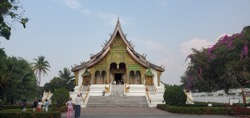
Luang Prabang, Chillout Town of Laos
Luang Prabang is a charming and romantic UNESCO world heritage city, at least the old sections where the sidewalks are made of red brick and the buildings are a mix of French Colonial and traditional Laos. Sinuous blue-green rivers with old bridges, bamboo barges and boats crossing run through it on two sides. Bougainvillea spill out exuberantly everywhere, fragrant frangipani (known here as Champa) is the ubiquitous national flower and dooryard flower planting is treated as a soul art.
There are heaps of places to sit out all French café style and argue philosophy, as some of the French hippie wasters clearly do. There is also fine dining, which we engaged in for a few nights. The splurge was well worth it as they also teach you about Laotian cuisine. Laotian food is famously spicy and I was tired of places dialing down the heat for foreigners, so I requested a 4/5 in my Green Papaya Salad and 5/5 level of heat in my Tofu Larp. I have to say, it delivered. They waiter kept coming by to see if steam came out my ears and seemed impressed that a foreigner could stomach it.
Probably 75% of the businesses in the old part of town are restaurants, cafés or guesthouses. The rest sell handicrafts from, or purportedly from, Laotian tribespeople. It’s nice to see them value the artwork and craft of the local people. There are a few places where you can learn about the tribes, their cultures, and the goods they now produce to sell based on their traditional work. One of the NGO groups from here, TEAC, were part of the international campaign to pressure Max Mara after they stole traditional Oma patterns and used them in their designer clothing. As a result, the Oma have now had all the elements of their traditional designs catalogued so they can claim cultural intellectual property if it happens again. It’s a brilliant idea and the goal is to support all the local tribes to do this, although it is labour and cost intensive.
Anything not a restaurant, handicrafts place or guesthouse is a Wat, or temple. Laos practices a unique version of Theravada Buddhism. Traditionally, every man or boy was meant to serve as a monk or novice sometime before they married and they could be a monk for as little as a week or two. They are meant to have no possessions beyond what they carry in their bag, although you will sometimes see monks at the market clearly haggling for luxury items or see their cellphone wrapped up within their monk robes.
The multitude of temples aren’t the rich gold glittery palaces of Thailand. They once were more so than they are now, but their glitter has long faded. Many of them are seeking donations to start or continue renovation. Chinese tourists come in by the literal busload to visit them and hopefully are donating. They definitely take part in Tak Bat, or the gathering of alms. The monks here live off food donations and so they go out from their various monasteries at 6am in procession and people line up along the route to provide them with food and/or money. We knew this was a thing, and our guesthouse is near a number of Wats, but we were not expecting the literally screaming hordes of Chinese tourists to arrive outside the door of our guesthouse at 5:30am on their way to give alms. Whelp, I guess we are going up as well since we’re awake.
The official process is that you buy or bring sticky rice, crackers, or things from a small recommended list and that you sit along the sidewalk all respectfully covered with no hat or sunglasses and, when the monks pass with their alms bowls just after 6am, you put in some sticky rice or packets of whatever to each bowl. The Chinese tourists were in hats and standing up flashing cellphones directly in their faces, which the monks stoically ignored. Laotians are quite non-confrontational.
Additionally, women should not touch or interact with the monks beyond basic alms giving because we are filthy as fuck. Well, at least I am. I’ll admit as much, although the men I know aren’t any less filthy.
I understand that after the monks do the alms gathering, they eat their first meal of the day around 7am and their last meal is at 11am. No eating after noon (except for the guys who sneak off to eat at the night market.) Sounds like a long time to go without eating and then only receiving sticky rice or sweet cracker packets.
There is signage everywhere about how to act in Laos to not offend the locals, and it frustrates me how resoundingly tourists ignore it. They do not like loud and, if someone has a loud voice, you will hear the Laotian speak more and more quietly to try and get the foreigner to follow the quietness. The big one is that Laotians are offended by miles of exposed skin. There are signs all over the place beseeching people not to go to Wats or proper respectful places in shorts, tank tops or bikini tops, and yet the typical female tourist is in a crocheted bikini top or close-fitting crop tank and flowing pants or short shorts. If men aren’t in elephant pants, they are in shorts. No one at the Wats will likely say anything, but if it’s someplace where you have to buy a ticket to enter, someone will send you back to the entrance to come back in a sarong around your waist or with a shawl around your upper body.
Laos feels like it knows it is backwards and is trying to catch up. Some of that is a result of geography - this place is mountainous and everything is difficult. Things are expensive because almost everything is imported. People apologize all the time for the quality of everything, except the food. The data is slower than molasses & wifi rarely works. The stamps are just paper and require you to have a glue stick. Amazon doesn’t deliver here. The gas is still leaded and they run out of it frequently and close the gas stations. ATMs run out of cash all the time. Despite it being Communist, there is no government money to fix anything. The roads are beyond atrocious. The National Museum won’t let you take photos, and yet has no merch to sell you of the interiors. You’ll just have to remember what the mosaics looked like. People try to build amazing things here but it doesn’t seem like there is a lot of support. One fella was telling us that he thought it was getting better because “the government doesn’t disappear many people anymore.” That’s a pretty low bar, dude.
What Laos does have is natural beauty, pretty cool architecture, rich histories, incredible food, and seriously lovely wonderful people. And it’s the land of a million elephants.
Leave a Reply
Posted by
Share: 

