
The Dirt on Kathmandu
The first thing that strikes you is that Kathmandu is a dusty town. Maybe 1 in 5 people wear masks or scarves against the dust stirred up in the air. Aside from that it looks like a more civil version of a large Indian city. Traffic is terrible and walking usually seems a better option. There are traffic police everywhere to direct and to stop you from parking in touristic areas and they are really not kidding about it.
There are differences from Indian cities. This was the first place where I have seen an openly advertised abortion support centre. It is also the first time I have seen condoms advertised - Manforce Jasmine flavoured condoms. Manforce, indeed.
The other thing that strikes you is how much damage there still is from the 2015 earthquake. Durbar Square, which was once the home to the palace and many, many temples is fundamentally destroyed. Much of the palace is crumbled and some of what is still standing is twisted and cracked. Ancient temples are reduced to their foundations and the rubble of the actual temples has been removed. We were told that many people were killed when Shiva’s temple, the famous “Hippy Temple,” collapsed. Many buildings of the square are wrapped in bamboo scaffolding and “China Aid” signs, or are being supported by wooden beams.
It’s not just the centre, either. Nepali traditional homes are made from mud and either stones or brick, which fell apart during the earthquake. The countryside is full of newer homes as a result.
One of the buildings that is braced all around but still standing is the palace of the Kumari. The Kumari is understood to be the manifestation of a goddess in a young girl. She used to be the goddess to the king but Nepal royalty are no more. In 2001 the crown prince killed his entire family at a dinner party, minus one uncle who became an unpopular king who was voted out a short while later, making Nepal a republic. Anyway, this young child is understood to house the goddess until she is 16. At that point the goddess leaves her body and the girl goes back to her family. The current Kumari is 5 years old and was discovered as the incarnation of the goddess when she was 3. We were very lucky that she came to her window when we were present. She looked around the courtyard of the chowk with a serious intense gaze for a few seconds before moving back from the window. To me, it felt a bit electric but some people in my group found it disturbing. Did we actually see a living goddess or a messed up, lonely little girl?
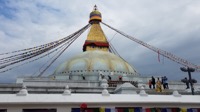
Bouddhanath Stupa is one of the worlds largest stupas and a Kathmandu must see. It consists of a large white dome on a series of plinths that seen from above create a mandala. Above that is a golden pinnacle painted on all four sides with the eyes of Buddha and on top is a pure gold spire donated by Tibet. The entire golden top was destroyed in the earthquake and reconstructed with the help of donations. At the bottom of all this is a circuambulation path used by a crimson profusion of monks, nuns and pilgrims. Incense, prayer flags, singing bowls and chant cds are for sale all around the site so it’s loud and busy. I bought a Green Tara prayer charm and had it blessed by a holy midget. He wasn’t dressed as a priest but he was very thorough in his blessings. One guy who was dressed as a priest just wanted to be in selfies. People aren’t always what they seem.
One of my favourite sights are the clusters of old men in their patterned Nepali hats sitting and gossiping. They put hipsters to shame with their stylishness.
Leaving Kathmandu for Pokhara one sees charming agriculture based villages terraced under the gorgeous mountain vistas. Broken down vehicles are pulled over to the side of the road with tree branches sticking out of the front and back bumpers to signal. Road crews of men and women sledge larger rocks and work in teams to shovel sand and gravel under a burning sun. I cannot imagine Canadians being willing to do this sort of labour by hand.
Leave a Reply
Posted by
Share: 

